AED Approval Ratings and AED Approval: Why FDA Approval Matters Most
A clear guide to AED approval ratings in New Zealand, including FDA approval, TGA approval, CE marking, and Medsafe WAND registration, plus what NZ workplaces should look for.
AED Approval Ratings: Why They Matter for New Zealand Workplaces
Choosing an automated external defibrillator (AED) for your workplace or organisation in New Zealand is a critical decision. One key factor to consider is the regulatory approvals or certifications the AED has. You may see labels like FDA approved, CE marked, TGA approved, or Medsafe WAND registered. What do these mean, and why is FDA approval often considered the gold standard. This article breaks down the different AED approval ratings with a focus on why FDA approval is the most important. It also explains how Australian TGA and New Zealand Medsafe WAND registrations fit into the picture and why a CE mark alone is not enough.
What Are AED Approval Ratings
AED approval ratings refer to the official certifications or clearances from regulatory agencies that indicate an AED has met certain safety and performance standards. These approvals are essentially quality and safety stamps from authorities around the world.
United States
Australia
Europe
New Zealand
Each of these indicates that the AED manufacturer has met the regulatory requirements of a region. However not all approvals are equal in rigour or scope.
Certification Comparison: AED Approval Ratings by Region
| Certification | Region | What it Means |
|---|---|---|
| FDA Approval | United States | The AED has been evaluated by the US Food and Drug Administration for both safety and effectiveness. This process requires strong clinical evidence that the device can reliably detect cardiac arrest rhythms and deliver life saving shocks. This is the most demanding approval process in the world and is widely regarded as the gold standard. |
| TGA Approval | Australia | The AED is approved by the Australian Therapeutic Goods Administration and listed on the Australian Register of Therapeutic Goods. This confirms the device meets Australian safety and performance requirements which are aligned to international standards. It is a strong indicator of quality but often relies on evidence from CE or FDA rather than unique clinical testing. |
| CE Mark | Europe | The AED meets European regulatory and safety standards and is legally permitted to be sold in the European Union. CE marking focuses on conformity and safety rather than real world clinical effectiveness. It is a basic approval and should not be relied on alone for critical life saving equipment. |
| Medsafe WAND | New Zealand | The AED is listed in New Zealand’s medical device notification database. This is a legal requirement for sale but it does not involve testing or evaluation of the device. It simply records that the device is being supplied in New Zealand and what overseas approvals it holds. |
FDA Approval: The Gold Standard for AED Approval
Why FDA Approval Is Considered the Strongest AED Approval Rating
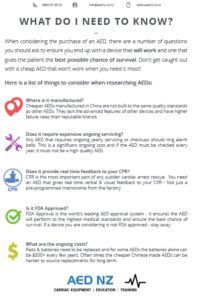
FDA approval is widely regarded as the highest standard for medical device regulation in the world. An AED that is FDA approved has undergone rigorous evaluation to prove it is both safe and effective in real emergency situations.
What FDA Approval Evaluates in AED Performance
The FDA requires manufacturers to provide detailed clinical and technical evidence that the AED correctly detects shockable heart rhythms and delivers appropriate therapy. This goes beyond electrical safety and manufacturing quality and focuses on whether the device actually improves survival in cardiac arrest.
Why FDA Approval Matters for New Zealand Organisations
No other regulatory system requires the same depth of clinical evidence before an AED is allowed to be sold. This is why FDA approval is considered the strongest possible indicator of reliability and performance.
An FDA approved AED has demonstrated that it works when it matters most. That makes FDA approval a critical purchasing factor for any organisation serious about safety.
CE Marking: Why CE Alone Is Not Enough for AED Approval
What CE Marking Means for AED Approval Ratings
CE marking is often misunderstood. It allows a product to be sold in Europe but it is not a guarantee of real world effectiveness.
Why CE Marking Does Not Prove Real World AED Performance
The CE process focuses on whether the device meets defined standards and whether the manufacturer has systems in place to manage risk and quality. It does not usually require new clinical trials or proof that the AED improves patient survival.
Why CE Only AEDs Should Be Treated as a Baseline
Because CE marking is faster and easier to obtain than FDA approval some manufacturers choose to stop there. That means a CE only AED may never have been tested in the way FDA approved devices are.
CE marking is a minimum requirement not a mark of excellence. It should be treated as a baseline not a deciding factor.
TGA Approval (Australia): How It Fits into AED Approval Ratings
What TGA Approval Means
TGA approval means the AED has been cleared for use in Australia. This is an important sign of quality because Australia has strong medical device regulation.
Why TGA Approval Does Not Replace FDA Approval
However the TGA system is largely based on international conformity and often relies on CE or FDA evidence rather than conducting its own clinical testing. It is a solid approval but it does not replace FDA review.
An AED with both FDA and TGA approval gives much greater confidence than one with CE alone.
Medsafe WAND (New Zealand): Legal Listing vs AED Approval
What WAND Registration Means in New Zealand
In New Zealand all medical devices must be listed in the WAND database. This is a legal requirement but it is not an approval.
Why WAND Is Not a Quality Approval
Medsafe does not test or certify AEDs. It simply records that the device is being supplied and what overseas approvals it holds. The responsibility for safety lies with the manufacturer and importer.
A WAND listing confirms legality not quality. Buyers should always look beyond WAND to see whether the AED is FDA approved or TGA approved.
What NZ Buyers Should Look For When Comparing AED Approval Ratings
- FDA approval because it proves real world clinical effectiveness.
- TGA approval because it shows the device has passed a major international regulator.
- CE marking as a basic requirement for international medical devices.
- WAND registration so the device is legally supplied in New Zealand.
Frequently Asked Questions About AED Approval and AED Approval Ratings
What does FDA approval mean for an AED +
It means the AED has been tested and proven to be both safe and effective at detecting and treating sudden cardiac arrest. This includes real world performance evidence not just laboratory testing.
Is a CE marked AED safe +
CE marked AEDs meet basic safety standards but CE alone does not prove the device will perform reliably in a real emergency. It should not be the only approval you rely on.
What is TGA approval +
It means the AED is approved for use in Australia and meets Australian regulatory requirements. It is a strong indicator of quality but does not replace FDA testing.
Does Medsafe approve AEDs +
No. Medsafe only requires devices to be listed in WAND. This is an administrative process not a quality approval.
What certifications should my AED have +
FDA approval is critical. TGA approval, CE marking and WAND registration in addition to FDA approval, provides the highest level of confidence in safety, effectiveness and legal compliance.