AED Comparison in New Zealand
If you are choosing an AED for a workplace, school, club, or public venue in New Zealand, this comparison breaks down the practical differences that matter, then it explains why the ZOLL AED Plus is our recommended option.
AEDs are designed to be used by everyday people under pressure, so the best device is the one that helps a rescuer do the right thing quickly.
The best choice comes down to which device will help in 100% of rescues, comes from a market leading manufacturer with a proven safe and clinically succesful device, and one that meets important medical guidelines, such as FDA approval.
What matters most when choosing an AED in New Zealand
In a cardiac arrest, the AED must be simple, loud, and clear. Features like real-time CPR feedback help rescuers maintain the right compression depth and rate, significantly increasing the chance of patient survival.
Ongoing ownership costs are also important. Pads and batteries expire, so comparing replacement frequency and consumables pricing gives a clearer view of 10-year cost of ownership. If you want help choosing the best AED for your site and budget, request a quote and we will recommend an option based on your environment and unique requirements.
Automated External Defibrillator (AED) Comparison
| Model | ZOLL AED Plus | LIFEPAK CR2 | Defibtech Lifeline | HeartSine 500P | St John PowerBeat X3 | AED 7000 |
|---|---|---|---|---|---|---|
| Provides active assistance during all cardiac arrest scenarios* | Yes | Yes | No | Yes | No | No |
| Manufacturer Location | USA | USA | USA | Ireland | China | China |
| Real Time CPR feedback | Yes. Detects compression depth and rate, and speaks to you with live feedback. |
None. Pre-programmed metronome only. |
None. Pre-programmed metronome only. |
Yes. Detects compression depth and rate, and speaks to you with live feedback. |
None. Pre-programmed metronome only. |
None. Pre-programmed metronome only. |
| IP rating | IP55 | IP55 | IP54 | IP56 | IP55 | Not specified |
| FDA Approval status | Yes | Yes | Yes | No | No | No |
| Electrode Pads Expiry | 5 years | 4 years | 2 years | 5 years | 4 years | 2 years |
| Batteries Expiry | 5 years | 4 years | 5 years | 5 years | 4 years | 5 years |
| Consumables Replacement Cost | Pads $199.00 Batteries $125.00 |
Pads $285.00 Batteries $572.00 |
Pads $195.00 Batteries $590.00 |
Pads $232.00 Batteries $232.00 |
Pads $265.00 Batteries $280.00 |
Pads: $129.00 Batteries: $199.00 |
| 10 Year Ownership Replacement Costs Total** |
Pads $199.00 Batteries $125.00 |
Pads $570.00 Batteries $1,144.00 |
Pads $780.00 Batteries $590.00 |
Pads $232.00 Batteries $232.00 |
Pads $530.00 Batteries $560.00 |
Pads $516.00 Batteries $199.00 |
| Total Replacement Actions Taken | 2 | 4 | 5 | 2 | 4 | 5 |
*For the purposes of this comparison, "Provides active assistance during all cardiac arrest scenarios" refers to whether a device is capable of delivering a defibrillation shock when a shockable rhythm is detected, AND providing real-time visual and verbal feedback to guide CPR when CPR is being performed.
Published cardiac arrest data indicate that a defibrillation shock is only required in approximately 40–50% of sudden cardiac arrests, while CPR is required in all cardiac arrests.
AEDs that do not provide real-time CPR feedback rely on the rescuer to judge compression depth and rate without device-based guidance.
AEDs that provide real-time CPR feedback can actively guide CPR performance during both shockable and non-shockable cardiac arrests.
A device such as the ZOLL AED Plus provides defibrillation when indicated and delivers real-time feedback during CPR, measuring compression depth and rate and providing audible prompts to help rescuers achieve guideline-recommended CPR performance. significantly increasing the chance of patient survival.
**Assumes the change is made on day 1 of the year following the expiry date.
Why we recommend the ZOLL AED Plus
In a real emergency, CPR quality is often the difference-maker, which is why we rate the ZOLL AED Plus so highly. The Real CPR Help feedback is clear and immediate, it helps a rescuer correct depth and rate in the moment, which is exactly when it matters.
It is also a practical long-term choice for New Zealand organisations because it is rugged, it has an IP55 rating, and features long life pads and batteries, which reduces maintenance cost and stress across multiple sites.
Request a quoteFAQ: AEDs in New Zealand
How often do AED pads need to be replaced?
It depends on the model. The electrode pads can expire every 2-5 years depending on the make and model, even if they have not been used.
How often do AED batteries need to be replaced?
Battery expiry varies by device. The batteries will expire every 2-5 years depending on the make and model, even if they have not been used.
What's the deal with AEDs made in the USA vs. China?
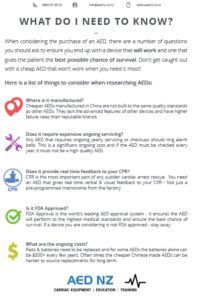
Products made in China are not built to the same medical testing standards as those made in the USA. FDA Approval is the world's leading approval metric for medical devices - in fact, medical devices cannot be sold in the USA without FDA approval. We've unfortunately heard many sad stories of people who have purchased a Chinese made AED, only to have it fail to work when they need it most. Don't take the risk!
📚 Sources & References
ZOLL's product information summarises evidence showing that Real CPR Help guides rescuers to deliver chest compressions at guideline-recommended depth and rate in real time, measured by accelerometer sensors in the electrodes, and provides immediate visual and audio feedback.
Multiple clinical studies show that when real-time feedback is available and rescuers can adjust performance accordingly, survival to discharge and good neurological outcomes have been documented to double as part of resuscitation bundles that include Real CPR Help and training.
These findings are consistent with larger retrospective analyses and clinical practice observations that high-quality CPR improves survival odds, and technology that helps ensure CPR quality (like real-time feedback) is a valuable tool in achieving that effect.
Bobrow BJ, et al. demonstrated a 2.7× increase in survival odds with Real CPR Help and training in Arizona, showing significant improvements in patient outcomes when real-time feedback technology is combined with proper training.
Technical specifications and product information sourced from ZOLL Medical Corporation, including Real CPR Help technology documentation and clinical evidence supporting the device's effectiveness in cardiac arrest scenarios.
Pricing sourced from a New Zealand distributor, January 2026.
Product specifications and technical details sourced from Stryker, the manufacturer of the LIFEPAK CR2. Information includes device capabilities, consumables lifespan, and operational features.
Pricing sourced from a New Zealand distributor, January 2026.
Technical specifications and product information sourced from Defibtech, including device capabilities, specifications, and operational features documented in official product materials.
Pricing sourced from a New Zealand distributor, January 2026.
Product specifications and user manual information sourced from HeartSine Technologies, documenting the PAD 500P's technical capabilities, features, and operational guidelines.
Pricing sourced from a New Zealand distributor, January 2026.
Technical specifications and product documentation sourced from ViVest, the manufacturer of the PowerBeat X Series. Information includes device features, user manual, and data sheet specifications.
Pricing sourced from a New Zealand distributor, January 2026.
Product information sourced from manufacturer documentation and distributor materials. The AED 7000 is manufactured in China and available through various international suppliers.
Pricing sourced from a New Zealand distributor, January 2026.